Caracara
Caracara is Amazon’s internal customer support platform used by Customer Service Associates (CSAs) to handle post-purchase inquiries. Redesigning the support workflow to process multi-item returns and exchanges in a single interaction — eliminating contact transfers for 5.5% of complex inquiries while maintaining resolution speed.
Project
Multi-item concession
Team
Customer Service Engagement
Role
UX Design
Timeframe
2019 - 2020
Status
Launched
The customer(s)
End Customers: Primary consumers contacting support who experience faster resolutions, fewer contact transfers, and less friction during multi-item returns or exchanges.
CSAs: Internal representatives whose day-to-day workflow is streamlined by eliminating redundant, single-item repetitive tasks.
Problem / Opportunity
For a long time, CSAs had worked with an old software that is optimized for handling single-item concessions.
When customer need help with more than one item - whether that’s a return, exchange, or both - CSAs had to either process each item separately, requiring more time, or transfer the contact to a specialist, cause customer friction and frustration.
Solution
Building on a “question tree” framework established for the updated customer service software to expedite resolutions for customer inquiries, we created a feature that also allows CSAs to process multi-item concessions in a single streamlined workflow.
Customer benefits
Faster Resolutions: Resolves multi-item returns and exchanges in a single interaction to minimize wait times.
Zero Transfer Resolution: Keeps customers with a single representative to eliminate hold times, transfers, and repeated explanations.
No Repetitive Steps: Removes the need for customers to repeat information or process items individually.
Current experience
Multi-item concessions need to account for multiple purchasing scenarios and issues at the item, package, and order levels.
Single-item concessions are straightforward, and don’t need to consider if customers ordered it with other items, or how they were delivered. Multi-item concessions, however, need to clarify these relationships to understand the affected entities of the customer’s request
Visualizing these multiple scenarios, which ranged in complexity, helped to clarify the potential use cases that need to be considered in a single concession workflow
Insights
Building a streamlined workflow also means optimizing speed. To achieve this, it’s important that CSAs can quickly understand the customer’s problem. However, one of the hypotheses was that customers and CSAs don’t have the same mental model when the problem and request are initially explained on the call.
Given the variables of how an order breaks down, it was important to take a customer-first approach and lean into how they think about their purchases. Listening to 100 customer calls and taking prompts from real customer inquiries, the pattern of their mental models and communication began to surface.
74%
Calls began with item info
24% of CSAs still asked for order number as follow-up
5%
Calls began with shipment info
Avg. time to take action was >2 mins - CSAs needed more detail
14%
Calls began with order info
Split between CSAs asking and customers offering the order number
5%
Calls began with order date
2%
Calls began with payment info
CSAs still needed an order number or item detail as follow-up info
0%
Calls began with delivery date
Usually the 2nd or 3rd piece of info provided by customers
Workflows
Scope + constraints: This project aimed to update and optimize the CSA-facing workflow, as opposed to redefining the established processes of return/exchange transactions.
Post delivery
Learning that customers typically identify an item to begin their request, I created a question tree experience that anchored on this to reveal related entities (items purchased together, shipped together, shipped separately, or shipped with items from different orders).
This guides CSAs through a set of decisions to quickly identify the problem, offer available options, and resolve customers’ issues.
Pre delivery
A question tree experience also had to be created for pre-delivery use cases, such as late delivery, missing packages etc.
Solution
With the added complexity, the solution achieved several goals:
Ensure an easy-to-learn workflow
Help CSAs understand the request quickly, communicate it effectively, and successfully guide customers through the resolution.
Clearly show how items, order, and packages break down, so CSAs and customers can effectively communicate with each other.
Help CSAs process multiple concessions in one transaction while ensuring customers get what they need.
How it’s built: The overall UI was built using an Amazon design system created for internal tools.
Final designs
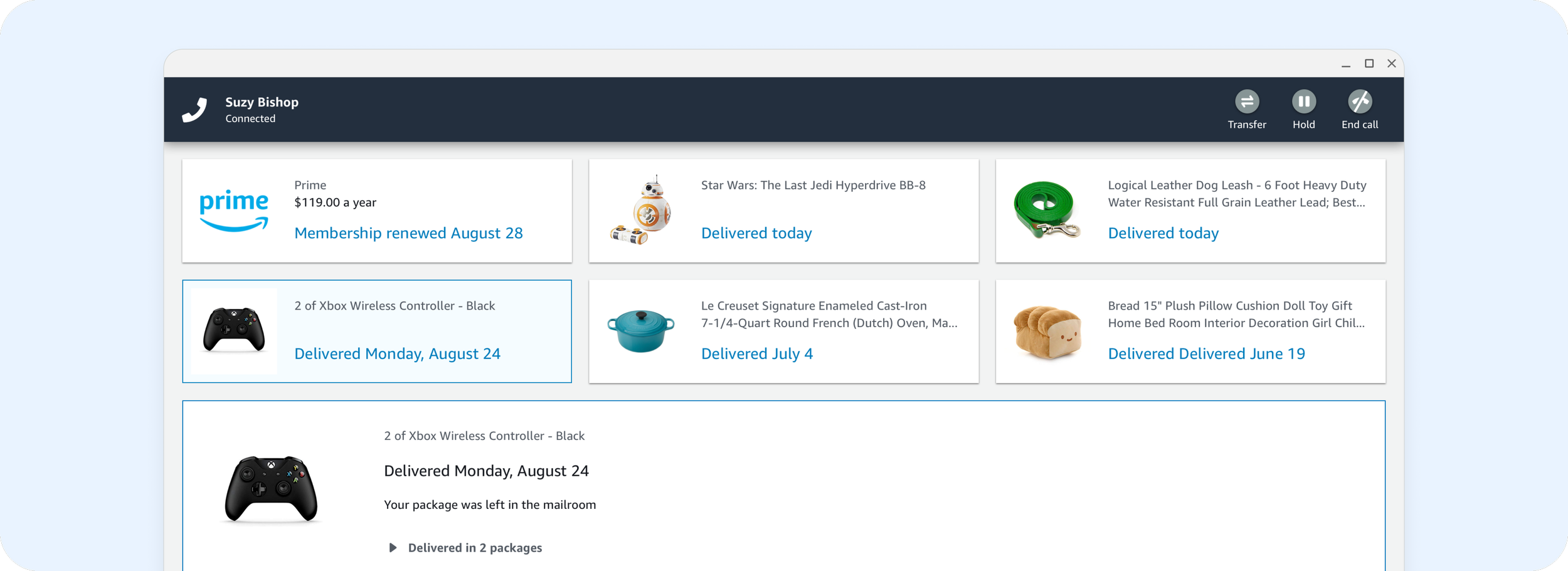
Solution card - Selecting an item card reveals additional levels of detail that may be relevant. This begins the question-tree workflow where each step asks one question to determine the path to resolution.
Item cards - Cards identifying the last 6 items the customer purchased are shown by default. Additional metadata is shown next to the item description (e.g. “2 of Xbox Wireless Controller - Black”) to provide a trail of other levels of detail for CSAs.
Solution card - The question tree is meant to prompt CSAs to ask the required questions and surface talking points as if reading a script. Logistical decisions (e.g. which items are packaged together, return shipping options) are determined on the backend and shown as part of the script for CSAs.
Item details - Additional details including delivery info are shown in this section for reference.
Impact
Quantitative
5.5%
Previously unsolvable contacts became solvable without the need to transfer customers to a specialist
Qualitative
After this experience was launched, CSAs were able to handle these more complex calls in roughly the same amount of time as before at 5.7 minutes.