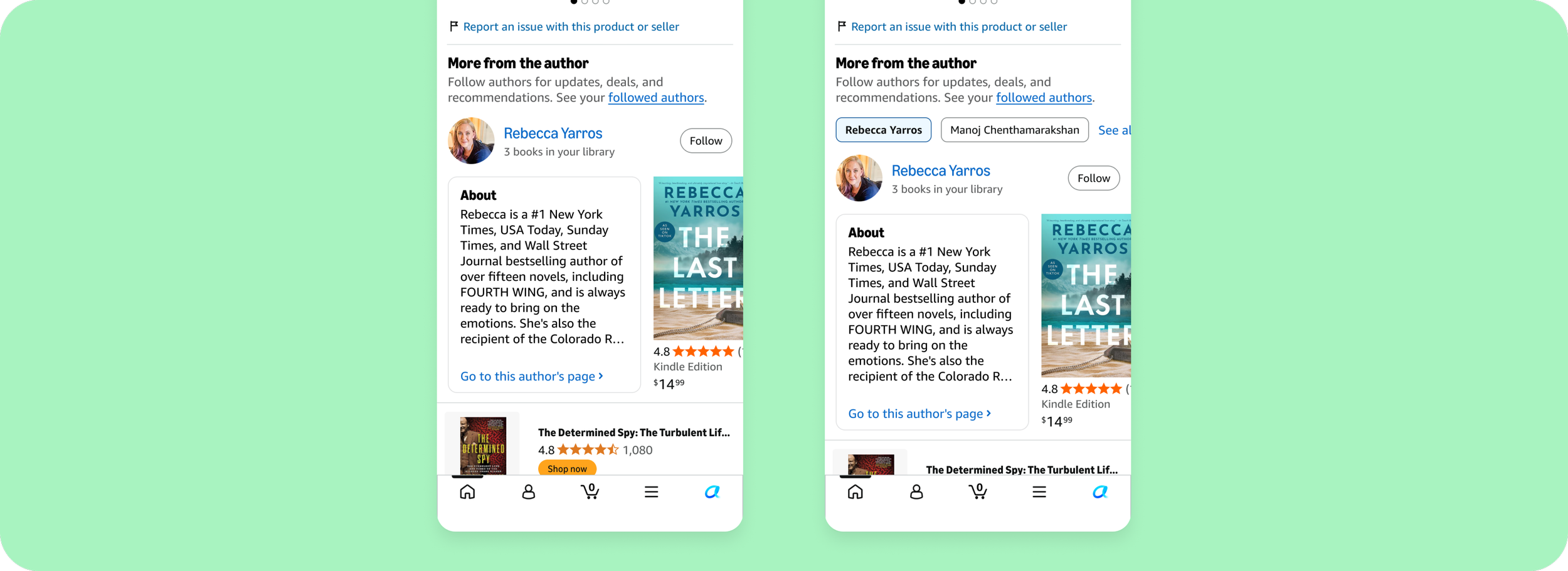
Author card
Redesigning the Books detail page “About the Author” card to pair author biographies with author-specific book recommendations — transforming static profiles into an active driver for author and series continuation. Targeting a Q4 2026 launch.
Product
Author Follow
Team
Books Design
Role
UX Design
Timeframe
2026
Status
In experiment (target launch - Q4 2026)
The customer(s)
Two sides of the same books customer:
Detail-Page Evaluators: Amazon Books shoppers determining if a specific title aligns with their reading preferences.
Returning Readers: Customers revisiting titles they already own or borrowed specifically to surface fresh, relevant recommendations.
Problem / Opportunity
The Books detail page relies heavily on author and series relationships to drive sales—series and author continuation alone account for 46% of transactions. However, today’s author widget focuses on isolated biography instead of the guidance readers want, such as where to start, new releases, and related titles.
Solution
By pairing author info directly with their recommended books on the detail page, the updated "About the author" card transforms into an active evaluation and discovery tool—helping readers effortlessly find an author's other work while leveraging Books' strongest conversion driver.
Customer benefits
The updated author widget puts one of the customers' most trusted discovery path right where they're deciding what to read next. Readers lean on authors as a discovery criterion, and pairing that with their other books, we meet customers with the connections they're already looking for—turning a static bio into a helpful path to their next read.
Insights
Research to understand customers’ needs revolved around asking several questions:
How do customers browse the store make their purchasing decisions?
How do customers evaluate and validate an author and their work?
What attributes of a book are most important or valuable?
What are customers’ perceptions of the detail page?
46%
Transactions involving series and author continuation
Most powerful discovery vector in Books
85%
Paid units from recommendation strategies based on similarities
On mobile detail page — indicates customers convert when they’re shown similar books
20%
Daily transacting customers revisit a detail page of a book they own
Customers revisit pages to evaluate and discover other potential purchases
Additional insights
Customers use authors as “spearfishing” anchors to branch out, relying on other books by/mentioned by authors they’ve read as a key source to gauge interest.
Author credentials are more important for non-fiction than fiction — these are seen as helpful qualifiers to highlight credibility.
Competitive analysis
Auditing similar internal and external examples revealed few platforms serve a dedicated evaluation and discovery opportunity within a creator’s space.
Findings:
There are validated industry patterns for consistency - i.e. list view for multiple creators
Most platforms focus on creator info as strictly evaluation
Vertical height seems to be a non-issue for most - either has minimal info or doesn’t need to compete with other sales opportunities
Apple Music presented the closest UX and pattern for our use case.
Amazon
IMDb
Goodreads
Letterboxd
Indigo
Barnes & Noble
Spotify
Strictly evaluative
Only creator bio shown
Same as book detail page on Amazon
Content focuses more on who the creator is
Spotify - Similar artists separate from artist card
List view only with no additional details on default view - need to click to separate page
Standard UX pattern for multiple creators - consistent
Carousel saves vertical space
Apple Music
“Similar Artists” in close proximity to artist info provides more visible discovery opportunity
Closest to design intent of updated author card
Uses additional height, but no competing content
Explorations
Scope and constraints
Simply add book recommendations for extra discovery/evaluative opportunity
No overhaul to existing “About the author” content
Use/align to Books design system
Minimal vertical height to avoid pushing content down
Show author bio only - other author attributes are not yet available
Need to scale for books by single and multiple authors
Changing interactions and navigation not in scope
Mobile only for MLP
Initial exploration: Stacked content
Goal: Aiming for simplicity, book recommendations are simply added below the existing author info.
Iterated exploration: Combined carousel
Goal: Combine author info and recommendations into one carousel to reduce vertical height while maintaining all required content.
Explorations: Author info
Goal: Drive standardized author follow pattern that can be reused in other parts of the store while maintaining minimal vertical height
Control
Card anatomy
Explorations: Book recommendations
Goal: Devise strategy to offer valuable discovery options while supporting customers’ intent to use other books as source of evaluation.
Author info
Optimize layout for content to combine with book recommendations: Header, Follow button, author image/bio, whyline re. followed author program
Purpose: Evaluation
Book recommendations
Use established carousel interaction with header and book cover faceouts to stay consistent with rest of detail page
Purpose: Discover and evaluation
Card orientation
Given the amount of content on detail page, concerns around vertical height persisted requiring a different layout that doesn’t simply add another widget.
Final design
The solution: An updated “About the Author” card on detail page that combines both author information with book recommendations in a single carousel while minimizing vertical height.
The updated header — “More from the author” — communicates the added discovery vector this card provides.
Use case: 1 author
Two treatments were delivered for experimentation — one with the author bio at the front of the carousel versus another at the end. The different placements aim to understand what detail is more valuable to customers. The findings may result in a consistent experience or opportunity for deeper personalization.
Use case: 2 or more authors
When a book has more than one author, the design maintains the same proposed treatment with the addition of toggle buttons to allow customers to switch to each author info and recommendations. This is intended to minimize the vertical height that results in adding book recommendations for each author.
Edge cases
Additional designs to cover edge cases that may appear. No redesigns, but rather simply removing content that isn’t available.
Control - Current Author card with author image, bio, Follow button, and ingress to Author page.
Control - Multiple authors are stacked vertically up to 2 authors. Additional authors are listed at the bottom.
No author bio, only book recommendations available - When an author has no bio available, the “About” card is hidden, showing only the book recommendations. As such, the author name serves as the only ingress into their author page.
T1 - Updated with bio at front of shoveler, up to 20 recommendations, and indicator of owned/borrowed books in library.
No book recommendations, on author bio available - “About” card expands full width and truncates to 5 lines. Link to author page persists.
T2 - Updated with bio at back of shoveler, up to 20 recommendations, and indicator of owned/borrowed books in library.
Treatment - To minimize vertical space, toggles are shown to allow customers to switch views between authors.
No author bio and book recommendations - Author follow lockup persists providing a single ingress into the author page (via linked name).
Impact
Experiments in progress - The proposed treatments are in experimentation with a target launch in Q4 2026.
Overall hypothesis + success metric
We hypothesize that updating the current author card to serve both evaluation and discovery needs — by surfacing select author titles alongside author details — will improve the customer experience and result in a measurable lift in BBPU.
Qualitative intent
Testing the placement of the author bio card (front vs back of carousel) will also give us insight to whether customers prefer seeing the content before or after the recommendations — and in what context that occurs.